Quartz dust: what is dangerous
The dangerous part is the respirable fraction of the dust, the part that reaches the alveoli. Respirable quartz dust is the respirable fraction of crystalline silica in the forms quartz, cristobalite and tridymite. It arises wherever quartz-containing materials are worked: concrete, masonry, natural stone, ceramics, mortar, sand.
As an assessment benchmark TRGS 559 names 0.05 mg/m³ for quartz dust (respirable fraction), published by the Committee on Hazardous Substances in 2016. The value should be undercut wherever possible. Where technical and organisational measures cannot achieve that, exposure is to be minimised in line with the state of the art. Above the benchmark respiratory protection is to be used.
Avoiding dust comes first. Wet methods, extraction directly at the tool and removing dust with an industrial vacuum take priority under the German Hazardous Substances Ordinance. Respiratory protection adds to them, it does not replace them. Avoid sweeping and blowing off.
Which mask for which multiple
Under DGUV Rule 112-190 FFP2 is permitted up to 10 times, FFP3 and a half mask with P3 up to 30 times, the full-face mask up to 400 times. Relative to 0.05 mg/m³ this gives by calculation: FFP2 up to 0.5 mg/m³, FFP3 and half mask up to 1.5 mg/m³, full-face mask up to 20 mg/m³. You only know the actual concentration from measurement or assessment.
| Device | Up to | In the AirGuard Pro range |
|---|---|---|
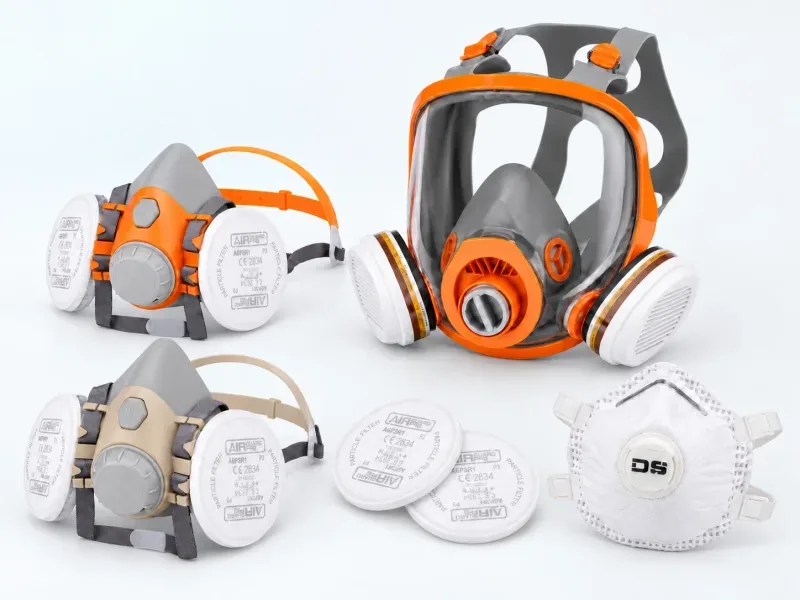
| Filtering half mask FFP1Disposable respirator 6100 | 4 × limit value | Disposable respirator 6100 |
| Filtering half mask FFP2Disposable respirators 6201, 6203 | 10 × limit value | Disposable respirators 6201, 6203 |
| Filtering half mask FFP3Disposable respirators 6311, 6311C, 6312 | 30 × limit value | Disposable respirators 6311, 6311C, 6312 |
| Half mask with particle filter P1Alternative: AG360 with AGP3R1 or AGP3R2 (P3, up to 30 × limit value) | 4 × limit value | Alternative: AG360 with AGP3R1 or AGP3R2 (P3, up to 30 × limit value) |
| Half mask with particle filter P2Alternative: AG360 with AGP3R1 or AGP3R2 (P3, up to 30 × limit value) | 10 × limit value | Alternative: AG360 with AGP3R1 or AGP3R2 (P3, up to 30 × limit value) |
| Half mask with particle filter P3AG360 with AGP3R1 or AGP3R2 | 30 × limit value | AG360 with AGP3R1 or AGP3R2 |
| Full-face mask with particle filter P1Alternative: AG700 with AGP3R1, AGP3R2 or AGP3R (P3, up to 400 × limit value) | 4 × limit value | Alternative: AG700 with AGP3R1, AGP3R2 or AGP3R (P3, up to 400 × limit value) |
| Full-face mask with particle filter P2Alternative: AG700 with AGP3R1, AGP3R2 or AGP3R (P3, up to 400 × limit value) | 15 × limit value | Alternative: AG700 with AGP3R1, AGP3R2 or AGP3R (P3, up to 400 × limit value) |
| Full-face mask with particle filter P3AG700 with AGP3R1, AGP3R2 or AGP3R | 400 × limit value | AG700 with AGP3R1, AGP3R2 or AGP3R |
| Half mask with gas filterAG360 with gas or combination filter (bayonet) | 30 × limit value | AG360 with gas or combination filter (bayonet) |
| Full-face mask with gas filterAG700 with gas or combination filter | 400 × limit value | AG700 with gas or combination filter |
| Situation | Suitable | Note |
|---|---|---|
| Short jobs, little dust | FFP2, for example 6201 | Industry rules name FFP2 as minimum protection where dust is visible. |
| Regular work, more dust | FFP3 6311 or half mask AG360 with P3 | Up to 30 times. With the half mask only the filter is replaced. |
| Very high concentration, eye protection needed | Full-face mask AG700 with P3 | Up to 400 times. |
Limits
- Face seal: a beard or sideburns in the sealing area prevent protection, see Face seal and beards.
- Concentration above the protection level: above 30 times (FFP3, half mask) or 400 times (full-face mask) a different device is needed.
- Other substances: TRGS 559 does not apply to asbestos or other fibrous dusts, separate rules apply there. Paints, adhesives and epoxy add vapours and need a gas filter, see Respiratory protection for painting.
- Health care: rules on occupational health care apply to respiratory protection, see Respiratory protection duties.
If you know the multiple of the limit value, the respirator finder leads to the matching combination.
Frequently asked questions
Which mask protects against quartz dust?
A particle mask: FFP2, FFP3 or a half mask with P3 filter. Which level is enough depends on how high the concentration is compared with the benchmark of 0.05 mg/m³.
Is FFP2 enough for grinding concrete?
Up to 10 times the benchmark, by calculation 0.5 mg/m³. When grinding, milling and cutting without extraction the concentration is often higher. Then FFP3 or a half mask with P3 make sense. The risk assessment decides.
Does the mask replace extraction?
No. Wet methods and extraction at the tool come first. Respiratory protection is added.
Does a particle filter protect against vapours from epoxy and adhesive?
No. Particle filters hold back only particles. Against vapours you need a gas or combination filter.