What gets into the air you breathe when painting
Solvents evaporate and then are in the air as a gas or vapour. When spraying, tiny paint droplets add to this, the paint mist. A gas filter holds back gases and vapours, a particle filter holds back mist and dust. When brushing and rolling the vapours dominate, when spraying both occur, and sanding dry paint layers produces sanding dust.
Respiratory protection is the last step of protective measures. Under the German Hazardous Substances Ordinance the first steps are substituting hazardous substances, technical measures such as a booth, extraction and ventilation, and organisational measures. Where these do not suffice, respiratory protection adds to them.
Which filter for which job
| Job | Filter | AirGuard Pro (bayonet, class 1) |
|---|---|---|
| Brushing, rolling: mostly vapours | Gas filter type A, with particle part if needed | AGABEKK1 or AGA1E1 |
| Spraying: vapours and paint mist | Combination filter type A with P3 | AGA1E1 (A1E1P3 R D) or AGABEKK1P3 (A1B1E1K1P3 R D) |
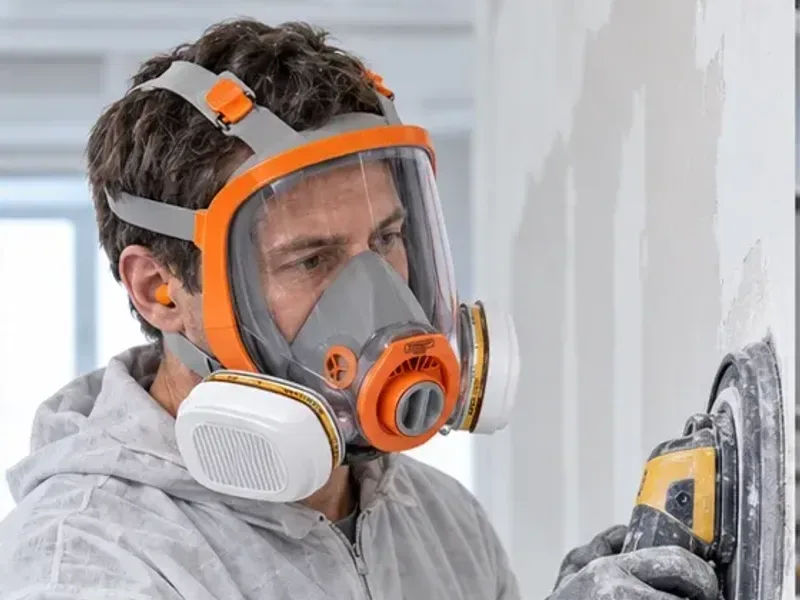
| Sanding dry paint: dust only | Particle filter P3 | AGP3R1 or AGP3R2 |
What the markings mean is explained in Respirator filter colour codes. Why there are particle filters with and without a gas part is covered under Choosing the right respirator filter.
Which mask fits
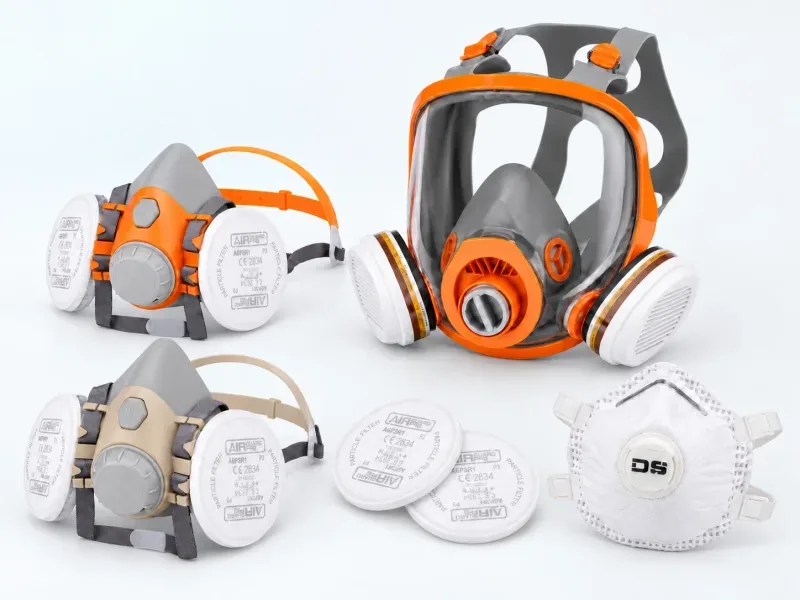
The half mask AG360 is permitted up to 30 times the workplace exposure limit under DGUV Rule 112-190, the full-face mask AG700 up to 400 times. The full-face mask also protects eyes and face, for example against splashes and irritating vapours. The gas filter itself has its own limit: class 1 applies up to 0.1 % by volume, that is 1,000 ml/m³. The stricter of the values always applies. The calculation is in Half mask or full-face mask.
| Class | Maximum | AirGuard Pro |
|---|---|---|
| Class 1 | 0.1 % by volume (1,000 ml/m³) | AGA1E1, AGABEKK1, AGABEKK1P3 (bayonet) |
| Class 2 | 0.5 % by volume (5,000 ml/m³) | AGA2E2, AGABEK2, AGABEK2P3 (RD40) |
| Class 3 | 1.0 % by volume (10,000 ml/m³) | not in the range |
When a filtering respirator is not enough
- Boiling point up to 65 °C: AX filters exist for very volatile substances. The AirGuard Pro range has none.
- Concentration unknown or too high: Without an entry in the safety data sheet or a measurement there is no reasoned filter choice. Above the limit of the filter class or the protection level a filtering respirator is not permitted.
- Oxygen not certain: Filters do not supply oxygen. In tanks, pits and confined spaces you need breathing apparatus independent of the ambient air. The instructions for use of the filters state at least 19.5 % by volume.
- Two-component paints: They can contain isocyanates. The safety data sheet shows this. Then agree the choice with the occupational safety specialist.
- Booth or spray stand without sufficient extraction: The filter does not replace ventilation.
Changing filters
Change gas filters according to a fixed change schedule, at the latest when you notice smell, taste or irritation from contaminants. This is what the instructions for use of the AirGuard Pro gas filters say. We cannot state a fixed service life in hours: it depends on substance, concentration, breathing volume and humidity, and the schedule comes from the risk assessment. Keep opened filters airtight. More under Changing filters.
Do not forget the face seal
The best filter does not help if the mask does not seal. A beard or sideburns in the sealing area prevent this. Check the fit every time you put the mask on, as described in Face seal and beards.
Checklist before painting
- Read the safety data sheet: substances, boiling point, workplace exposure limit (AGW) and notes on isocyanates.
- Clarify the concentration: measured or known from the risk assessment?
- Choose filter type and class, with P3 when spraying.
- Choose the mask by protection level, the full-face mask if eye protection is needed.
- Set a change schedule and check the face seal.
If you know substance, concentration and oxygen content, the respirator finder leads to the matching combination from the range.
Frequently asked questions
Is an FFP2 mask enough for painting?
No. FFP masks hold back only particles, that is paint mist and dust. They do not protect against solvent vapours. For that you need a half mask or full-face mask with a gas or combination filter.
Which filter protects against solvent vapours in paint?
A filter with type A, provided the boiling point of the solvents is above 65 °C. When spraying, a P3 part against the paint mist is added. Which solvents are in the paint is stated in the safety data sheet.
How long does a gas filter last when painting?
The instructions for use do not state a fixed time. It depends on substance, concentration and breathing volume. Change according to a change schedule, at the latest at smell, taste or irritation.
Can I paint in a confined space with respiratory protection?
Only if the oxygen content is certainly sufficient and ventilation is right. Filters do not supply oxygen. In tanks and confined spaces with unclear air a filtering respirator is not permitted.