Type and colour: what the filter protects against
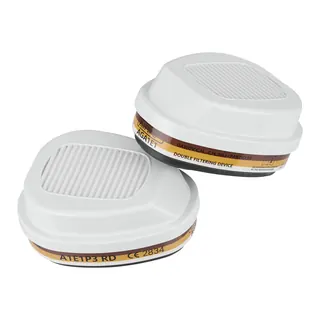
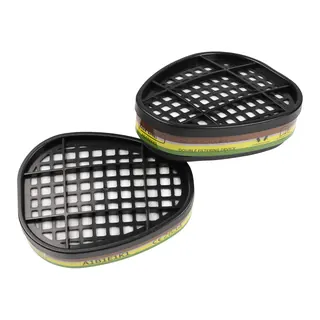
Gas filters are marked to EN 14387 with a type letter and a colour code, particle filters to EN 143 with P and white. Combination filters carry the colours of all their parts side by side, so an ABEK-P3 filter shows brown, grey, yellow, green and white.
| Type | Protects against | AirGuard Pro |
|---|---|---|
| A | Organic gases and vapours with a boiling point above 65 °Ce.g. Solvents such as toluene, xylene or white spirit | in the range |
| B | Inorganic gases and vapourse.g. Chlorine, hydrogen sulphide, hydrogen cyanide | in the range |
| E | Sulphur dioxide, hydrogen chloride and other acid gases | in the range |
| K | Ammonia and organic ammonia derivativese.g. Amines | in the range |
| P | Particles: dust, smoke, miste.g. Classes P1, P2, P3 | in the range |
| AX | Organic compounds with a boiling point up to 65 °C | not in the range |
| SX | Substances named by the manufacturer | not in the range |
| NO-P3 | Nitrous gases (nitrogen oxides) | not in the range |
| Hg-P3 | Mercury vapour | not in the range |
No filter protects against everything. ABEK filters do not retain carbon monoxide, for example, and A filters are not tested for organic substances with a boiling point up to 65 °C; AX filters exist for those. The safety data sheet of the substance states which type is needed.
Gas filter classes: how much gas
The number after the type letter is the class. It limits the gas concentration up to which the filter may be used. The limits come from DGUV Rule 112-190:
| Class | Maximum | AirGuard Pro |
|---|---|---|
| Class 1 | 0.1 % by volume (1,000 ml/m³) | AGA1E1, AGABEKK1, AGABEKK1P3 (bayonet) |
| Class 2 | 0.5 % by volume (5,000 ml/m³) | AGA2E2, AGABEK2, AGABEK2P3 (RD40) |
| Class 3 | 1.0 % by volume (10,000 ml/m³) | not in the range |
Regardless of the class, the protection level of the mask applies: half mask up to 30 times, full-face mask up to 400 times the workplace exposure limit. The stricter of the two values applies. How to calculate is explained under Half mask or full-face mask.
Particle filters: P1, P2, P3
Particle filters retain dust, smoke and mist. P3 has the highest retention. On a half mask P1 is permitted up to 4 times, P2 up to 10 times and P3 up to 30 times the limit value, on a full-face mask P3 up to 400 times. AirGuard Pro only offers P3.
R, NR and D
- NR (not reusable): the particle filter is limited to one shift.
- R (reusable): the particle filter may be used beyond one shift. How long exactly is given in the instructions for use.
- D: the filter passed the additional dolomite dust test and clogs more slowly.
Example: A1B1E1K1P3 R D
This is how the marking of the combination filter AGABEKK1P3 reads: gas filter against types A, B, E and K, each class 1, that is, up to 0.1 % by volume. Plus a P3 particle filter, reusable (R) and with a passed dolomite dust test (D).
The AirGuard Pro filters
| Item | Marking | Protects against | Connection | Fits | Standard | Packaging |
|---|---|---|---|---|---|---|
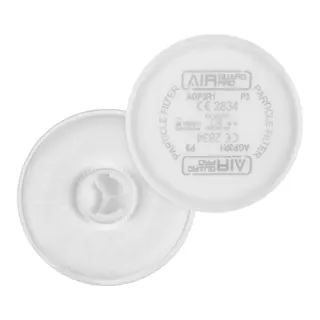
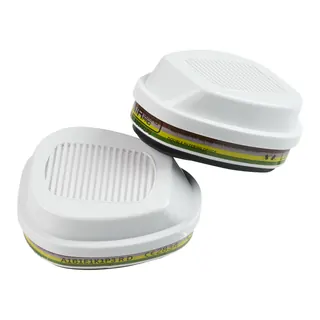
| AGP3R1 | P3 R | particles | Bayonet | AG360, AG360W and AG700 | EN 143:2021 | 50 pairs, each pair in a foil bag |
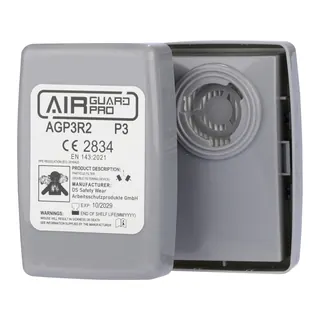
| AGP3R2 | P3 | particles | Bayonet | AG360, AG360W and AG700 | EN 143:2021 | 72 pairs, 6 pairs per box |
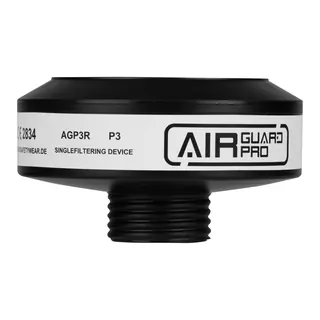
| AGP3R | P3 | particles | RD40 | AG700 | EN 143:2021 | 20 pieces, each in a box |
| AGA1E1 | A1E1P3 R D | organic vapours, acid gases, particles | Bayonet | AG360, AG360W and AG700 | EN 14387:2004+A1:2008 | 25 pairs |
| AGABEKK1 | A1B1E1K1 | organic vapours, inorganic gases, acid gases, ammonia | Bayonet | AG360, AG360W and AG700 | EN 14387 | 30 pairs, each pair in a foil bag |
| AGABEKK1P3 | A1B1E1K1P3 R D | organic vapours, inorganic gases, acid gases, ammonia, particles | Bayonet | AG360, AG360W and AG700 | EN 14387:2004+A1:2008 | 30 pairs, each pair in a foil bag |
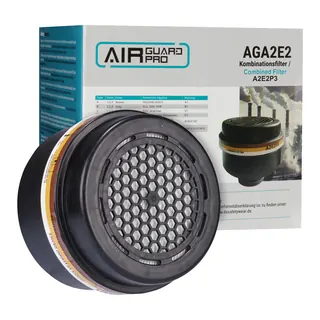
| AGA2E2 | A2E2P3 | organic vapours, acid gases, particles | RD40 | AG700 | EN 14387:2021 | 20 pieces, each in a box |
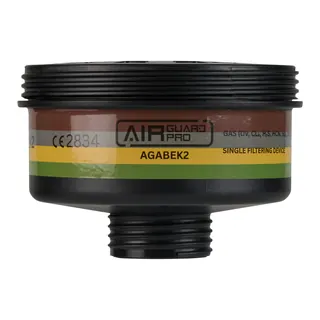
| AGABEK2 | A2B2E2K2 | organic vapours, inorganic gases, acid gases, ammonia | RD40 | AG700 | EN 14387:2021 | 20 pieces, each in a box |
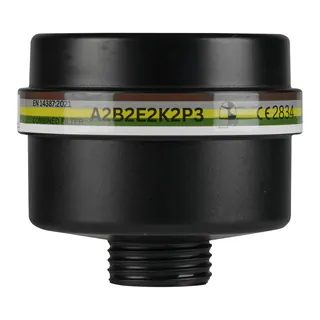
| AGABEK2P3 | A2B2E2K2P3 | organic vapours, inorganic gases, acid gases, ammonia, particles | RD40 | AG700 | EN 14387:2021 | 20 pieces, each in a box |
Frequently asked questions
What colour is an A2P3 filter?
Brown for gas filter type A and white for particle filter P. The number 2 is the gas filter class and has no colour of its own.
What does ABEK on the filter mean?
The filter protects against four groups: A organic gases and vapours with a boiling point above 65 °C, B inorganic gases, E acid gases and K ammonia and organic ammonia derivatives.
Which filter protects against solvent vapours?
A filter with type A, provided the boiling point of the solvent is above 65 °C. For lower boiling points you need an AX filter. The safety data sheet states the boiling point.
Does a particle filter protect against gases?
No. Particle filters only retain dust, smoke and mist. Against gases and vapours you need a gas or combination filter.