Applications

Respirators and filters by application

Whether grinding metal, drywall, painting or cleaning: which respirator and filter come into question depends on the hazardous substances and the working conditions. Discover typical applications for AirGuard-Pro respirators and filters. The examples show possible combinations and explain what matters in the selection: type of substance, concentration and required protection level.

The examples are for guidance and do not replace a risk assessment. Safety data sheets provide information on the substances used. The actual concentration at the workplace must be determined separately. When selecting, observe the conditions of use and the instructions for use of mask and filter.

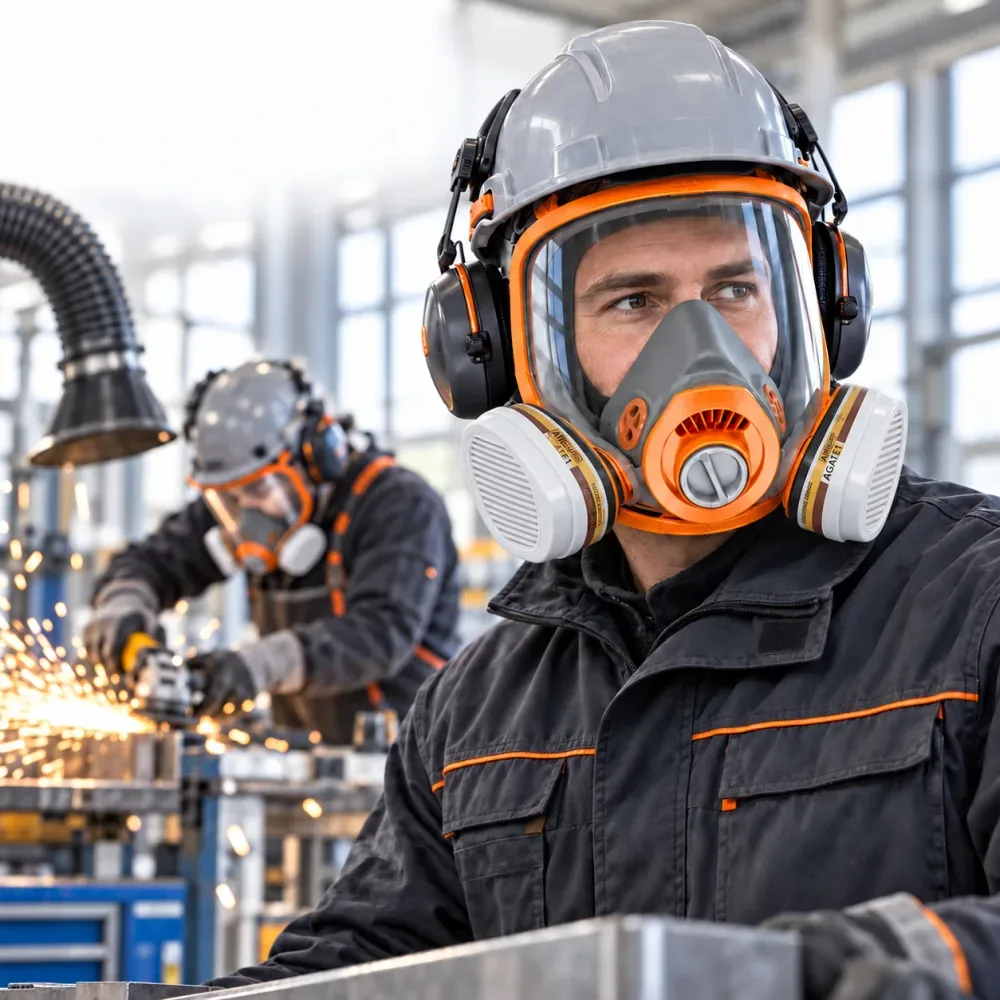
Employee wearing a full-face respirator in a metal workshopAI-edited

Focus topic

Asbestos work under TRGS 519

Asbestos is carcinogenic, and work on it is tightly regulated. Respiratory protection is one building block alongside technology, qualification and decontamination. Here you read what TRGS 519 requires and where our devices fit and where they do not.

  1. 01

    The rules

    The Hazardous Substances Ordinance and TRGS 519 for demolition, refurbishment and maintenance work. TRGS 517 applies instead to potentially asbestos-containing mineral raw materials, for example in quarries or recycling.

  2. 02

    Risk areas

    Low, medium, high by fibre concentration. Approval of the company, notification and qualification depend on it: competent supervision, trained employees.

  3. 03

    Respiratory protection by concentration

    FFP2 at 10,000 to 100,000 fibres per m³, FFP3 up to 300,000, above that a powered device. FFP masks for two hours per shift at most. The current TRGS 519 is authoritative.

  4. 04

    What we do not promise

    AirGuard Pro does not advertise devices for remediation in the high risk area. We do not offer powered or breathing apparatus. Which devices come into question is clarified in advice.

Only companies and employees with the prescribed qualification may carry out asbestos work. The statements on the TRGS are based on the 2014 edition and the presentations of the German statutory accident insurers; TRGS 519 is being adapted to the amended Hazardous Substances Ordinance. Check the currently valid version. More in the guide

Metalwork, workshop, maintenance

Grinding, cutting and derusting metal

Angle grinder, belt sander or wire brush on steel, rust and coated parts.

In the air
Grinding dust and rust particles, solid particles without gases.
Why this selection
A particle filter is enough against dust. The half mask with P3 filter is permitted up to 30 times the workplace exposure limit. AGP3R1 is a flat filter disc, AGP3R2 has a glass fibre filter medium in a plastic housing.

Watch out for

  • Sparks and chips: the particle filter replaces neither face nor eye protection. Anyone who must protect eyes and face takes the full-face mask AG700.
  • Old coatings can contain lead or chromium(VI). Additional rules then apply, selection only with expert advice.


Construction, finishing, renovation

Sanding drywall filler, plaster and mortar

Sanding filler and plaster, mixing mortar, working plasterboard.

In the air
Mineral fine dust without gases.
Why this selection
A P3 filter on the half mask is enough here too. The flat AGP3R1 gets in the way less than a filter in a housing when working overhead.

Watch out for

  • Quartz-containing fine dust, for example when cutting concrete or natural stone, is carcinogenic. Special rules apply: selection with expert advice.
  • If a material also contains volatile substances according to its safety data sheet, you need a combination filter.

Vehicle body repair, paint shop, joinery

Painting with solvent-based paints

Spraying or brushing paints and thinners, outside or beside a booth.

In the air
Solvent vapours (organic vapours, type A) and paint mist (particles).
Why this selection
The combination filter A1E1P3 R D binds organic vapours in activated carbon and at the same time retains the paint mist with a P3 filter. Class 1 applies up to 0.1 % by volume gas concentration, the half mask up to 30 times the limit value.

Watch out for

  • Type A only protects against organic substances with a boiling point above 65 °C. For more volatile substances the range has no filter.
  • Two-component paints can contain isocyanates: check the safety data sheet and agree the selection with the occupational safety specialist.
  • Replace gas filters according to a change schedule, at the latest at odour, taste or irritation.

Construction, industrial flooring, model making

Floor coatings, bonding and resins

Processing epoxy resin, solvent-based adhesives and primers, also indoors.

In the air
Solvent vapours, dust as well when sanding.
Why this selection
A filter with type A protects against the vapours, a P3 part additionally against grinding dust when sanding. In rooms with poor ventilation or with strongly irritant vapours the full-face mask AG700 makes sense because it also protects the eyes.

Watch out for

  • In confined or poorly ventilated rooms the oxygen content can drop. If that cannot be ruled out, no filtering respirator may be used.
  • Ventilation and extraction come first: respiratory protection is the last level of protection measures.

Building cleaning, swimming pool, food business

Cleaning and descaling with acidic or chlorine-based agents

Mixing and applying descalers, acid cleaners and chlorine products.

In the air
Acid gases such as hydrogen chloride (type E), chlorine and other inorganic gases (type B).
Why this selection
Type E binds acid gases such as hydrogen chloride and sulphur dioxide, type B inorganic gases such as chlorine. The A1B1E1K1 gas filter AGABEKK1 covers both. For pure acid vapours the AGA1E1 is also enough.

Watch out for

  • Never mix chemicals: acid and chlorine cleaners release chlorine gas. That belongs in the instruction, not in the filter.
  • In accidents or with unknown concentration a filtering respirator is not permitted.

Agriculture, animal husbandry

Stable work and handling feed

Mucking out, bedding, decanting feed in stables with a noticeable smell of ammonia.

In the air
Ammonia (type K) and organic dust, also with mould spores.
Why this selection
The combination filter A1B1E1K1P3 R D contains type K against ammonia and a P3 filter against dust, so one pair of filters covers both.

Watch out for

  • Slurry pits, silos and tanks: oxygen can be lacking there or hydrogen sulphide can occur at high concentration. A filtering respirator is not permitted there, you need breathing apparatus.
  • Pathogens and sensitising dusts belong in the company's risk assessment.

Refrigeration engineering, food industry

Maintenance on refrigeration systems with ammonia

Work on systems where small leaks or residual gas can occur.

In the air
Ammonia (type K) at a higher but known concentration.
Why this selection
The full-face mask AG700 is permitted up to 400 times the limit value and protects eyes and face. The class 2 RD40 gas filters are permitted up to 0.5 % by volume gas concentration and are therefore intended for higher concentrations than the class 1 bayonet filters.

Watch out for

  • Only with a known concentration. In a larger release or unknown conditions a filtering respirator is not permitted.
  • Gas filters are replaced according to a change schedule, even if they do not seem used up.

Demolition, industry, building cleaning

Very dusty work and cleaning after construction

Tidying and sweeping in dense dust, emptying dust collectors, work where eye protection is needed.

In the air
Fine dust at high concentration without gases.
Why this selection
If the dust concentration is above 30 times the workplace exposure limit or the eyes are to be protected, the full-face mask AG700 with P3 filter is the right choice: permitted up to 400 times. AGP3R sits singly in the centre on the RD40 thread, AGP3R1 and AGP3R2 in pairs at the sides on the bayonet.

Watch out for

  • Asbestos and other carcinogenic dusts require special procedures: selection only with expert advice.

  • Above 400 times the limit value no filtering respirator is permitted.

When a filter is not enough

  1. 01

    Oxygen unclear or too low

    Filters do not supply oxygen. In tanks, pits, shafts and confined spaces you need breathing apparatus. The instructions for use state at least 19.5 % by volume.

  2. 02

    Substance or concentration unknown

    Without information in the safety data sheet or a measurement there is no reasoned filter choice.

  3. 03

    Asbestos, carcinogenic and radioactive substances, pathogens

    Additional rules apply here, for example TRGS 519 in Germany. Selection belongs in the risk assessment with expert advice.

  4. 04

    Carbon monoxide, nitrous gases, mercury, volatile organic substances

    The AirGuard Pro range has no filters for these (CO, NO-P3, Hg-P3, AX).

  5. 05

    Concentration above the protection level

    Half mask up to 30 times, full-face mask up to 400 times the workplace exposure limit. Gas filters also only up to the limit of their class.

More on selection: Choosing the right respirator filter, Filter classes and colours and Half mask or full-face mask. All filters at a glance: Respirator filters.

For purchasing and occupational safety

Your job is not listed?

Describe the substance and the situation. We name the matching combination from the range or tell you openly if there is no filter for it.

The brand family of DS SafetyWear Arbeitsschutzprodukte GmbH

