Important up front: this article explains the rules and places our products. It replaces neither TRGS 519 nor the risk assessment, the notification to the authority or the advice of a competent person. Only companies and employees with the prescribed qualification may carry out asbestos work. The rules described are German; other countries have their own.
Why asbestos is so tightly regulated
Asbestos fibres are carcinogenic. They are so fine that they reach the lungs and stay there. Manufacture and use have been banned in Germany since 1993, but buildings erected before then still contain asbestos in many components, such as fibre cement sheets, plasters, fillers, floor coverings and pipe insulation. The danger arises when such materials are worked on and fibres are released.
Which rule applies to what?
| Rules | Applies to |
|---|---|
| GefStoffV (Hazardous Substances Ordinance) | Legal framework: protective measures, notification, approval and qualification for work with asbestos. The ordinance was amended in December 2024 (risk-based concept). |
| TRGS 519 | Demolition, refurbishment and maintenance work (ASI) on components containing asbestos. |
| TRGS 517 | Work with potentially asbestos-containing mineral raw materials, for example in quarries, further processing and recycling. It applies instead of TRGS 519, not in addition. |
| DGUV Rule 112-190 | Use of respiratory protective devices: selection, wearing times, instruction. |
Risk areas: low, medium, high
Since the amendment of the Hazardous Substances Ordinance, protective measures, approval and notification depend on the risk area. The basis is the fibre concentration in the air, taking the planned protective measures into account. According to BG ETEM, low risk is below 10,000 fibres per cubic metre, medium risk between 10,000 and 100,000 and high risk above. TRGS 519 assigns activities to the areas in an exposure-risk matrix.
- For activities in the high risk area the company needs an approval.
- All employees doing asbestos work must be trained (Fachkunde), and a supervising person must be competent (Sachkunde). Sachkunde is acquired through an officially recognised course.
- Transition periods apply that run until 2026 and 2027. The competent occupational safety authority clarifies which apply to your company.
Technical measures first, then respiratory protection
As with all hazardous substances, technical and organisational measures take priority: low-emission methods, wetting, sealing off the work area, extraction at the source with suitable equipment and a decontamination airlock. Respiratory protection protects workers in addition, not instead. Protective suits and gloves, which are disposed of after the work, complete the equipment. DS SafetyWear has a separate guide on choosing the protective suit and on disposal (in German).
Which respiratory protection when?
The previous version of TRGS 519 (2014 edition) ties respiratory protection to the fibre concentration. The sources describing the new risk concept still rely on it until the revised version is available. Check the figures in the currently valid edition before using them in a risk assessment.
| Fibre concentration | Respiratory protection under TRGS 519 | In the AirGuard Pro range |
|---|---|---|
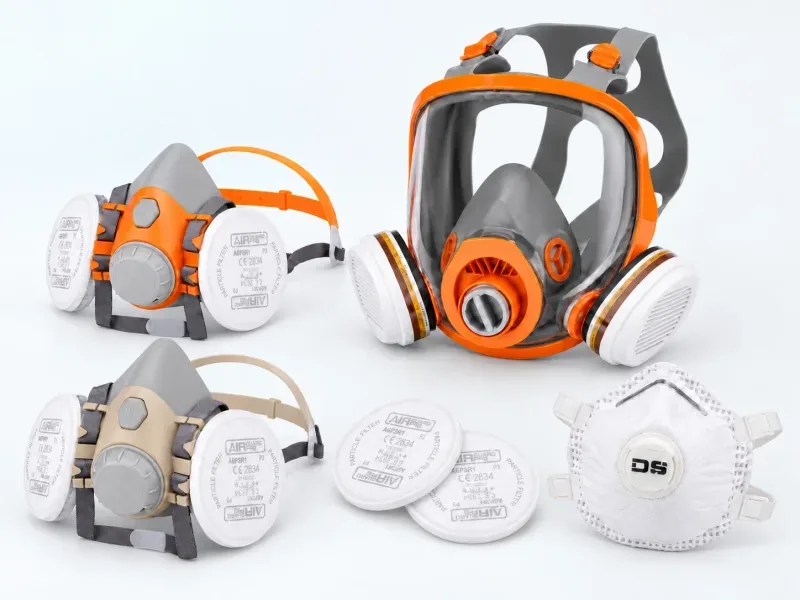
| 10,000 to 100,000 F/m³ | Filtering half mask FFP2, short-term only, at most 2 hours per shift | 6201, 6203 |
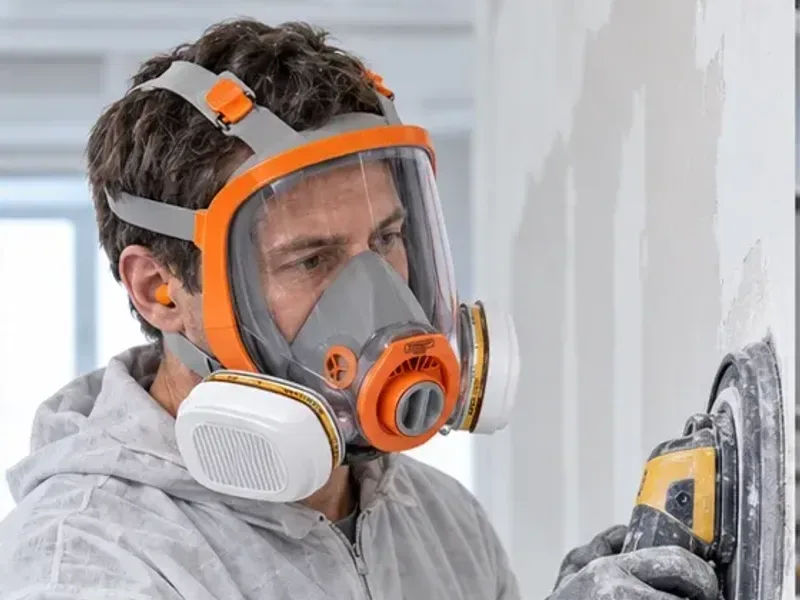
| 100,000 to 300,000 F/m³ | FFP3 half mask, at most 2 hours per shift, or a higher-grade device | 6311, 6312; higher-grade: full-face mask AG700 with P3 filter |
| above 300,000 F/m³ | Powered full-face mask with particle filter (TM3P) or a higher-grade device | not in the range |
| Sprayed asbestos, dry, above 4 million F/m³ | Breathing apparatus independent of the ambient air | not in the range |
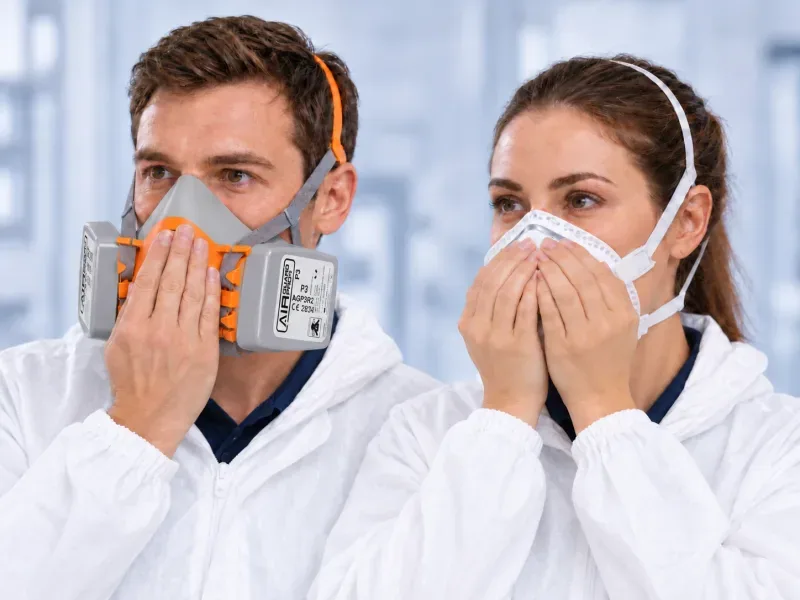
A half mask with P3 filter (AG360 with AGP3R1 or AGP3R2) has the same protection level as an FFP3 mask, but is more comfortable for longer jobs because the filter can be replaced and breathing resistance stays lower. At higher concentrations and longer jobs the technical literature recommends powered devices, because P3 filters are a burden when worn for long. AirGuard Pro does not offer powered or breathing apparatus.
What the employer must ensure for respiratory protection
- Respiratory protective devices are put on and taken off only outside the hazard area, that is in the decontamination unit.
- Employees are instructed and trained in use, see Respiratory protection at work: the duties.
- The face seal is checked; people with beards cannot wear tight-fitting masks, see Face seal and beards and Fit test.
- Devices are stored, cleaned and maintained properly.
- Wearing and recovery times follow DGUV Rule 112-190 and the risk assessment; for FFP half masks the limit is two hours per shift.
- Used disposable respirators, filters and suits are disposed of as asbestos-containing waste, not with normal waste.
What AirGuard Pro does not promise
AirGuard Pro does not advertise any device for asbestos removal in the high risk area. The instructions for use of our masks and filters are authoritative for selection. Whether a device may be used in your case is decided by the risk assessment together with your competent person. In the respirator finder, asbestos therefore leads to the result “Selection only with expert advice”. We advise you which devices from the range come into question for your activity and which do not.
Checklist for companies
- Have the material tested for asbestos before work starts (survey).
- Determine the activity and risk area under TRGS 519 and clarify notification and approval.
- Appoint a competent supervising person and trained employees.
- Define technical protective measures: low-emission method, extraction, sealing off, decontamination.
- Select respiratory protection by fibre concentration and set wearing times.
- Check the face seal and instruct employees; arrange occupational health surveillance.
- Collect and dispose of waste separately; keep the documentation.
Frequently asked questions
May I remove asbestos with an FFP2 mask?
Only if TRGS 519 and your risk assessment allow it for the activity. TRGS 519 (2014 edition) names FFP2 half masks for short-term work at concentrations of 10,000 to 100,000 fibres per cubic metre, at most two hours per shift. Above that you need FFP3 or higher-grade devices.
Which rule applies, TRGS 519 or TRGS 517?
TRGS 519 applies to demolition, refurbishment and maintenance work on components containing asbestos. TRGS 517 applies to work with potentially asbestos-containing mineral raw materials, for example in quarries or recycling. They are mutually exclusive.
Who may carry out asbestos work?
Companies and employees with the necessary qualification: a competent supervising person (officially recognised course) and trained employees. For work in the high risk area the company also needs an approval.
What do I do with used masks after asbestos work?
They count as asbestos-contaminated and are disposed of with the other waste of the activity as asbestos-containing waste, not with household waste. Your risk assessment governs the details.
Does an FFP3 mask reliably protect against asbestos?
An FFP3 mask retains fibres if it seals properly. It is intended only for certain concentrations and short jobs. Above 300,000 fibres per cubic metre TRGS 519 requires a powered device.
Sources
- TRGS 519 Asbestos: demolition, refurbishment and maintenance work (BAuA, Germany)
- New rules for handling asbestos (BG ETEM, etem 2/2025, Germany)
- Asbestos at the workplace: regulations and rules (DGUV, IFA, Germany)
- Hazardous Substances Ordinance (GefStoffV, Germany)
- DGUV Rule 112-190 “Use of respiratory protective devices” (Germany), November 2021 edition