What is the AGW?
AGW is the German abbreviation for Arbeitsplatzgrenzwert, the workplace exposure limit. It is the concentration of a hazardous substance in workplace air at which, according to current knowledge, no harm to health is expected even from daily work over a working life. It is stated in mg/m³ (milligrams per cubic metre of air) or in ml/m³ (ppm).
The AGW is a shift average, as a rule over eight hours. For many substances there are also short-term values that limit peaks. The Committee on Hazardous Substances (AGS) sets the values and publishes them in TRGS 900 (Germany).
Where do you find the AGW of a substance?
- in the safety data sheet of the substance, section 8 (“Exposure controls/personal protection”),
- in TRGS 900 of BAuA, by substance name or CAS number,
- in your company’s risk assessment, which contains the measured or determined concentration.
How to calculate: concentration divided by AGW
The AGW is not calculated; it is given. What you do calculate is by what multiple the concentration at your workplace exceeds the AGW. You compare this factor with the protection level of the mask.
- Determine the concentration at the workplace from measurement or the risk assessment.
- Look up the AGW of the substance.
- Divide the concentration by the AGW: the result is the factor.
- Choose a mask whose protection level is at least as high as the factor.
Example with assumed values: a dust has an AGW of 2 mg/m³, and 15 mg/m³ is measured at the workplace. 15 divided by 2 gives 7.5. An FFP1 mask (up to 4 times) is not enough; an FFP2 mask (up to 10 times) is sufficient. Take the next higher level if the value is just below the limit.
Protection levels of the masks
| Device | Up to | In the AirGuard Pro range |
|---|---|---|
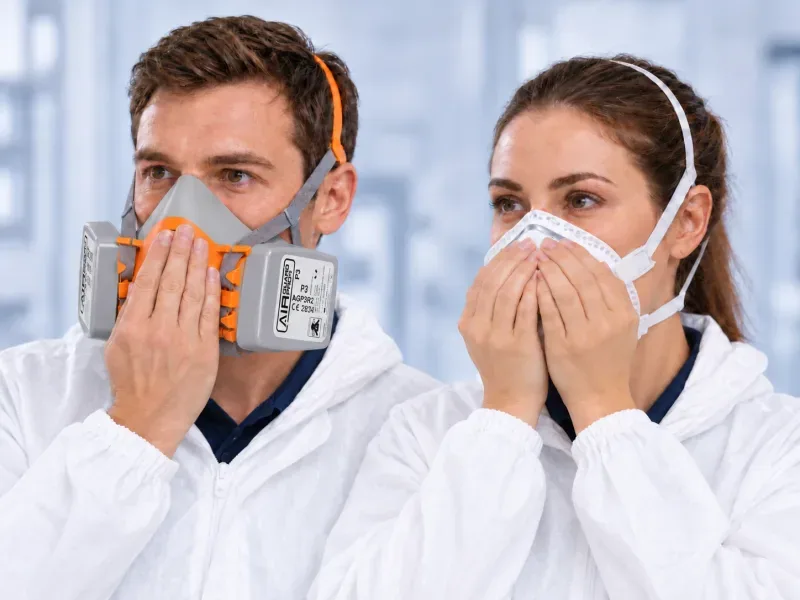
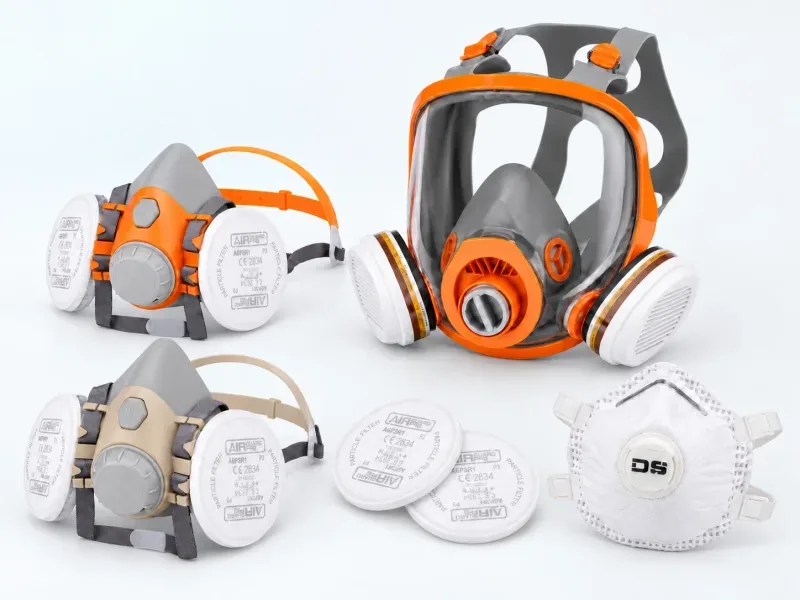
| Filtering half mask FFP1Disposable respirator 6100 | 4 × limit value | Disposable respirator 6100 |
| Filtering half mask FFP2Disposable respirators 6201, 6203 | 10 × limit value | Disposable respirators 6201, 6203 |
| Filtering half mask FFP3Disposable respirators 6311, 6311C, 6312 | 30 × limit value | Disposable respirators 6311, 6311C, 6312 |
| Half mask with particle filter P1Alternative: AG360 with AGP3R1 or AGP3R2 (P3, up to 30 × limit value) | 4 × limit value | Alternative: AG360 with AGP3R1 or AGP3R2 (P3, up to 30 × limit value) |
| Half mask with particle filter P2Alternative: AG360 with AGP3R1 or AGP3R2 (P3, up to 30 × limit value) | 10 × limit value | Alternative: AG360 with AGP3R1 or AGP3R2 (P3, up to 30 × limit value) |
| Half mask with particle filter P3AG360 with AGP3R1 or AGP3R2 | 30 × limit value | AG360 with AGP3R1 or AGP3R2 |
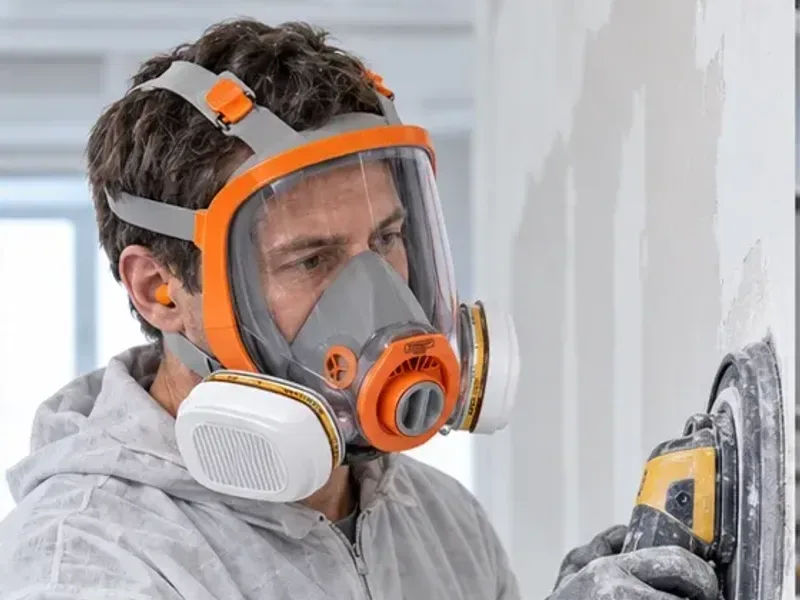
| Full-face mask with particle filter P1Alternative: AG700 with AGP3R1, AGP3R2 or AGP3R (P3, up to 400 × limit value) | 4 × limit value | Alternative: AG700 with AGP3R1, AGP3R2 or AGP3R (P3, up to 400 × limit value) |
| Full-face mask with particle filter P2Alternative: AG700 with AGP3R1, AGP3R2 or AGP3R (P3, up to 400 × limit value) | 15 × limit value | Alternative: AG700 with AGP3R1, AGP3R2 or AGP3R (P3, up to 400 × limit value) |
| Full-face mask with particle filter P3AG700 with AGP3R1, AGP3R2 or AGP3R | 400 × limit value | AG700 with AGP3R1, AGP3R2 or AGP3R |
| Half mask with gas filterAG360 with gas or combination filter (bayonet) | 30 × limit value | AG360 with gas or combination filter (bayonet) |
| Full-face mask with gas filterAG700 with gas or combination filter | 400 × limit value | AG700 with gas or combination filter |
The factors come from DGUV Rule 112-190 (Germany). For filtering devices the stricter value of mask and filter also applies; more in Half mask or full-face mask and FFP1, FFP2 or FFP3.
For gases and vapours a second limit applies
Besides the factor, gas and combination filters have a maximum concentration per gas class: class 1 up to 0.1 % by volume, class 2 up to 0.5 % and class 3 up to 1 %. Both must fit. Which filter belongs to which substance is explained in Choosing the right filter.
No AGW found? What to do
If no value turns up for a substance, that does not mean it is harmless. Proceed in this order:
- Search by CAS number. TRGS 900 often lists substances under another name. The CAS number is in the safety data sheet (section 1 or 3). For mixtures, the individual ingredients count.
- Read the safety data sheet. Section 8 sometimes gives values from other countries or manufacturer data besides the German AGW. Ask the supplier which assessment criterion applies and which respiratory protection it provides for.
- Check special rules. For dust without its own AGW there are general dust limits. Carcinogens have their own criteria (acceptable and tolerable concentration under TRGS 910, Germany), and biological agents fall under the Biological Agents Ordinance.
- Get an assessment. Your occupational safety specialist or occupational physician can measure or estimate the concentration and set the criterion. Under the Hazardous Substances Ordinance this is part of the risk assessment.
- Do not guess in the meantime. Without a reliable value, do not pick a mask on suspicion. Technical measures such as extraction and ventilation come first. We advise you on selection once the data is available.
Where the AGW is not enough
- For some substances, such as carcinogens, there is no AGW in the usual sense but other assessment criteria. The risk assessment then decides.
- With several substances at once the mixture must be assessed, not each substance on its own.
- With oxygen deficiency no filtering device helps, however low the factor.
- The respirator finder calculates the factor and shows suitable devices. It does not replace the risk assessment.
Frequently asked questions
What does AGW stand for?
AGW is the German abbreviation for Arbeitsplatzgrenzwert, the workplace exposure limit: the permitted average concentration of a hazardous substance in workplace air, as a rule over an eight-hour shift.
Where do I find the AGW?
In the safety data sheet (section 8) and in TRGS 900 of BAuA.
How do I calculate which mask I need?
Divide the measured concentration by the AGW. Compare the result with the protection level: FFP1 up to 4×, FFP2 up to 10×, FFP3 and half mask up to 30×, full-face mask up to 400×.
What does “10× AGW” mean?
The mask may be used if the concentration is at most ten times the AGW.