Why these dusts are special
Flour dust is a substance that can sensitise the airways. If the allergy starts with a runny nose and watering, itchy eyes, continued exposure can lead to breathlessness and baker's asthma. Once an allergy has developed, it cannot be cured. The higher the dust concentration, the more likely sensitisation. Grain and feed dusts act similarly, often with mould spores and bacteria added.
There is no workplace exposure limit for flour dust. TRGS 406 therefore requires measures that reduce exposure as far as possible: generate less dust, extract, clean wet, do not blow off with compressed air.
Which mask
A particle filter is enough against dust. Industry guidance from BGN names at least an FFP2 mask for work with flour dust, for example when handling sacks, recommended with an exhalation valve for lower breathing resistance. For longer or heavier exposure FFP3 or a half mask with P3 come into question. The multiple of the limit value cannot be stated for flour dust because there is no limit value. The risk assessment decides.
| Situation | Suitable | Note |
|---|---|---|
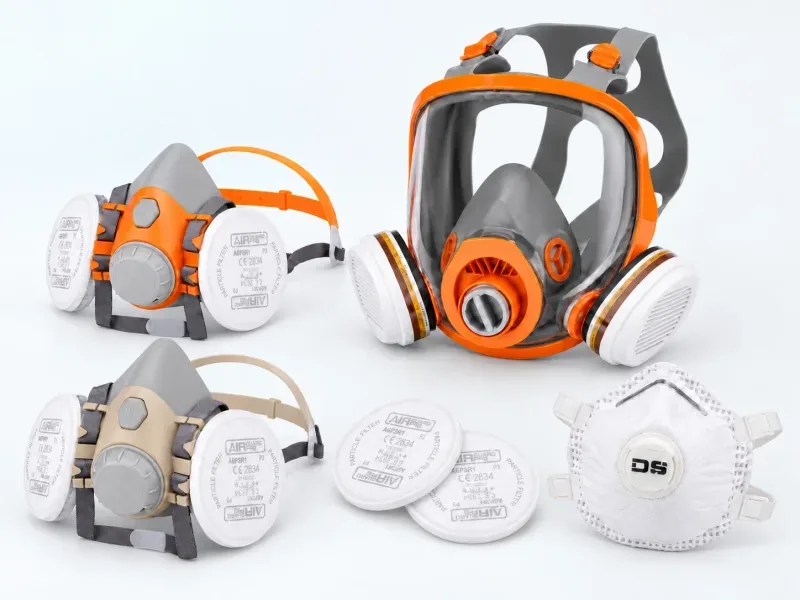
| Emptying a sack, working dough, short jobs | FFP2 with valve, for example 6201 | The valve lowers breathing resistance. |
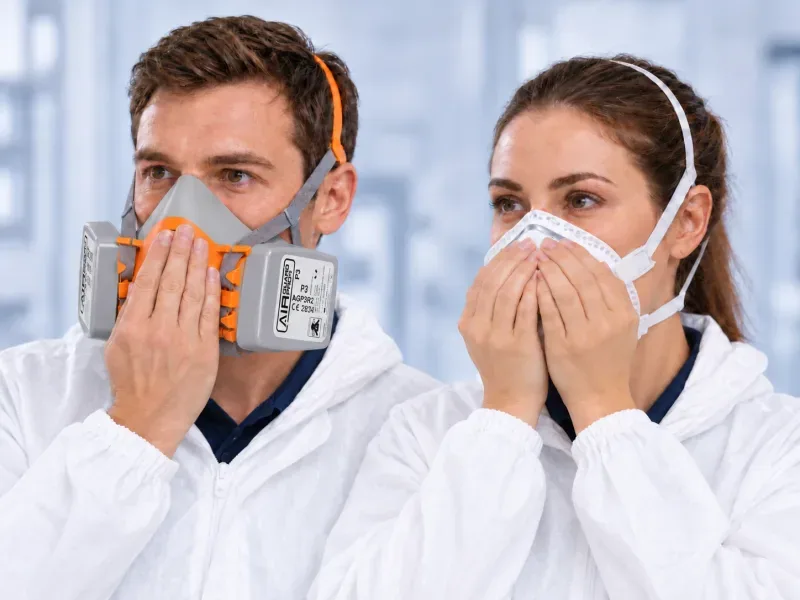
| Daily, long work, a lot of dust | FFP3 6311 or half mask AG360 with P3 | With the half mask only the filter is replaced. |
Limits
- Avoiding dust comes first: extraction, closed filling points, wet cleaning. Respiratory protection adds.
- Face seal: a beard or sideburns prevent protection, see Face seal and beards.
- Barn and silo: with gases such as ammonia, hydrogen sulphide or lack of oxygen a particle filter does not help, see Respiratory protection for ammonia.
- Health care: with flour dust and allergens occupational health care is important, see Respiratory protection duties.
An overview of mask types is in the respirator finder.
Frequently asked questions
Which mask for flour dust?
At least FFP2, BGN guidance recommends it with exhalation valve. With long or heavy exposure FFP3 or a half mask with P3.
Is there a limit value for flour dust?
No. There is no workplace exposure limit for flour dust, so exposure is to be minimised as far as possible.
What is baker's asthma?
An allergic airway disease caused by flour dust. It often starts with a runny nose and watering eyes and can lead to breathlessness. Once an allergy has developed, it cannot be cured.
Is a mask enough in a barn or silo?
Only against dust. Gases such as ammonia and lack of oxygen need other devices. Without a known concentration a filtering respirator is not permitted.
Sources
- DGUV Rule 112-190 “Use of respiratory protective devices” (Germany), November 2021 edition
- TRBA/TRGS 406 Respiratory sensitisers (BAuA, Germany)
- Flour dust, baker’s asthma and rhinitis (BGN, Germany)
- Preventing flour dust allergy (Suva, Switzerland)
- Instructions for use and data sheets of the AirGuard Pro products