Type K: the filter against ammonia
Under EN 14387 a gas filter of type K protects against ammonia and organic ammonia derivatives, for example amines. The colour is green. With AirGuard Pro the filters AGABEKK1 (A1B1E1K1) and AGABEKK1P3 (A1B1E1K1P3 R D) contain type K. The number 1 stands for class 1: the filter may be used up to 0.1 % by volume gas concentration, that is 1,000 ml/m³.
| Class | Maximum | AirGuard Pro |
|---|---|---|
| Class 1 | 0.1 % by volume (1,000 ml/m³) | AGA1E1, AGABEKK1, AGABEKK1P3 (bayonet) |
| Class 2 | 0.5 % by volume (5,000 ml/m³) | AGA2E2, AGABEK2, AGABEK2P3 (RD40) |
| Class 3 | 1.0 % by volume (10,000 ml/m³) | not in the range |
In the barn: ammonia and dust together
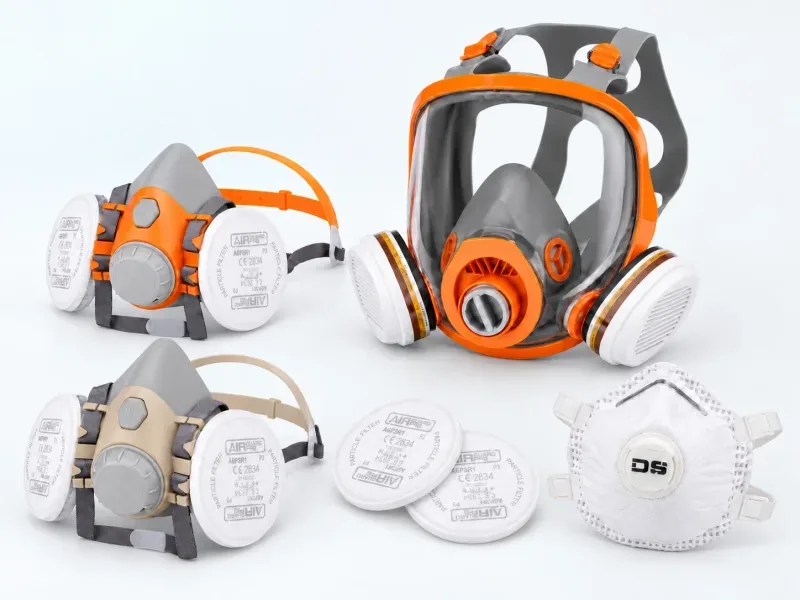
In animal barns ammonia and organic dust occur together, often with mould spores. A combination filter with type K and P3 covers both: AGABEKK1P3 on the half mask AG360, up to 30 times the workplace exposure limit under DGUV Rule 112-190.
Slurry pits, silos and tanks are different: oxygen can be missing there or hydrogen sulphide can occur in high concentration. Filtering respirators are not permitted there. Breathing apparatus independent of the ambient air is needed.
At refrigeration plants: known concentration, full-face mask
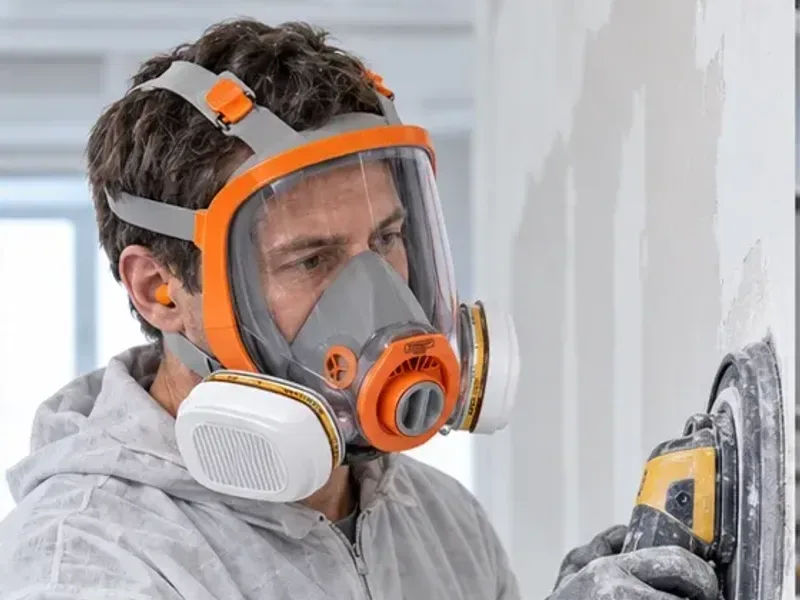
During maintenance on plants with ammonia, residual gas or small leaks can occur. The full-face mask AG700 protects eyes and face and is permitted up to 400 times the limit value. What matters is that the concentration is known and lower than the limit of the filter class. For higher concentrations there are gas filters of class 2. Which filters are permitted for what is governed by the instructions for use of the respective filter. You make the choice in the risk assessment with the occupational safety specialist.
When a filtering respirator is not permitted
- Larger release or incident: The concentration is unknown and can be above the limit of the filter. Then a filtering respirator is not permitted.
- Oxygen below 19.5 % by volume: This is the limit in the instructions for use. Filters do not supply oxygen.
- Confined spaces, tanks, pits: The oxygen content is not certain here, breathing apparatus independent of the ambient air is needed.
- Concentration above the protection level: The half mask goes up to 30 times, the full-face mask up to 400 times the limit value.
Changing and checking filters
Change gas filters according to a fixed change schedule, at the latest at smell, taste or irritation. This is what the instructions for use of the AirGuard Pro gas filters say. Dispose of filters if they were removed in contaminated air, cause breathing difficulties or are damaged. More under Changing filters. Check the face seal every time you put the mask on, as described in Face seal and beards.
For ammonia at a known concentration the respirator finder suggests the matching combination from the range.
Frequently asked questions
Does an ABEK filter protect against ammonia?
Yes, through type K. An ABEK filter covers the types A, B, E and K, so also ammonia and organic ammonia derivatives.
Is an FFP3 mask enough for ammonia?
No. FFP masks hold back only particles. Against gases such as ammonia you need a half mask or full-face mask with a type K gas filter.
Which filter for work in barns?
A combination filter with type K and P3, such as AGABEKK1P3, covers ammonia and dust. Slurry pits, silos and tanks are special cases that need breathing apparatus independent of the ambient air.
How often must I change the ammonia filter?
The instructions for use do not state a fixed service life. Change according to a change schedule from the risk assessment, at the latest at smell, taste or irritation.