First: the requirements of the product
For pesticides the instructions for use define which personal protective equipment is to be worn when mixing and applying. For disinfectants the active substances and protective measures are in the safety data sheet. These statements take precedence. This guide does not replace them, it helps with assigning the filter.
From active substance to filter
| In the air | Filter | Note |
|---|---|---|
| Organic solvents and vapours, boiling point above 65 °C (many spray and cleaning products with alcohol or solvent content) | Type A, with mist additionally P3: AGA1E1 (A1E1P3 R D) or AGABEKK1P3 (A1B1E1K1P3 R D) | See Respiratory protection for solvents. |
| Acidic active substances (for example peracetic acid, chlorine) | Type B or E | See Chlorine and acids. |
| Ammonia, amines | Type K | See Respiratory protection for ammonia. |
| Spray mist, aerosols, dusts (spray liquid, powder) | Particle filter P3 | Against droplets and dust only, not against vapours. |
| Type | Protects against | AirGuard Pro |
|---|---|---|
| A | Organic gases and vapours with a boiling point above 65 °Ce.g. Solvents such as toluene, xylene or white spirit | in the range |
| B | Inorganic gases and vapourse.g. Chlorine, hydrogen sulphide, hydrogen cyanide | in the range |
| E | Sulphur dioxide, hydrogen chloride and other acid gases | in the range |
| K | Ammonia and organic ammonia derivativese.g. Amines | in the range |
| P | Particles: dust, smoke, miste.g. Classes P1, P2, P3 | in the range |
| AX | Organic compounds with a boiling point up to 65 °C | not in the range |
| SX | Substances named by the manufacturer | not in the range |
| NO-P3 | Nitrous gases (nitrogen oxides) | not in the range |
| Hg-P3 | Mercury vapour | not in the range |
Mask and limits
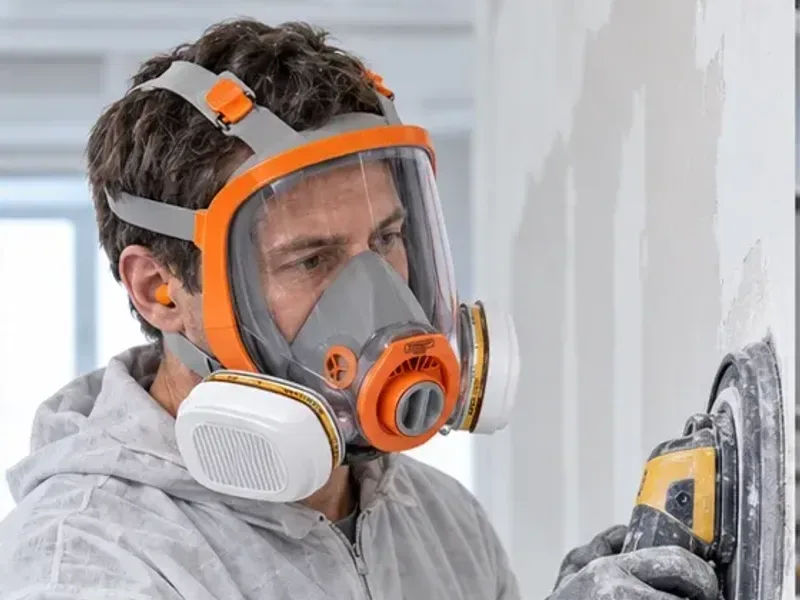
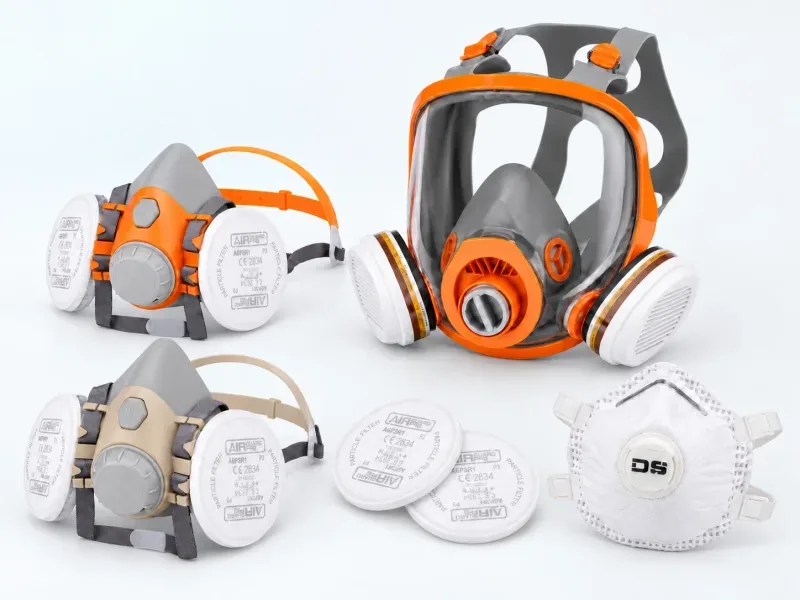
Under DGUV Rule 112-190 the half mask AG360 is permitted up to 30 times the workplace exposure limit, the full-face mask AG700 up to 400 times. Where spray mist can reach eyes and skin, the full-face mask makes sense. The gas filter has its own limit as well, class 1 applies up to 0.1 vol.%. The stricter value applies.
| Class | Maximum | AirGuard Pro |
|---|---|---|
| Class 1 | 0.1 % by volume (1,000 ml/m³) | AGA1E1, AGABEKK1, AGABEKK1P3 (bayonet) |
| Class 2 | 0.5 % by volume (5,000 ml/m³) | AGA2E2, AGABEK2, AGABEK2P3 (RD40) |
| Class 3 | 1.0 % by volume (10,000 ml/m³) | not in the range |
- Closed rooms, greenhouse, unknown concentration: Without a known concentration there is no justified filter choice. Filters supply no oxygen, the instructions for use name at least 19.5 vol.%.
- Fumigation and substances without a matching filter: if the active substance does not fit types A, B, E, K, a filtering respirator is not permitted.
- Skin: respiratory protection does not protect the skin. Add protective clothing and gloves as the product specifies.
- Instructions for use of the filters: replace gas filters at the latest at odour, taste or irritation, see Filter replacement.
If you know substance and concentration, the respirator finder leads to the matching combination.
Frequently asked questions
Which filter is needed for pesticides?
That is stated in the instructions for use of the product. For spray liquid, depending on the active substance, gas filters of type A and a particle filter P3 come into question.
Is an FFP mask enough when spraying?
Only if the label allows it and no vapours occur. FFP masks hold back only particles and droplets, no vapours.
Which filter for disinfectants?
That depends on the active substance in the safety data sheet: type A for organic vapours, B or E for acidic substances, K for ammonia.
May I work in a greenhouse with a filter?
Only if concentration and oxygen content are known and the filter suits the substance. With unknown concentration a filtering respirator is not permitted.