Why the boiling point decides
Gas filters of type A bind organic gases and vapours to activated carbon. Under EN 14387 they are tested for this when the boiling point is above 65 °C. For substances with a boiling point up to 65 °C, AX filters are intended. The AirGuard Pro range has no AX filter.
Examples: which side of the line is the substance on?
| Solvent | Boiling point (approx.) | Type A suitable? |
|---|---|---|
| Acetone | 56 °C | No, AX needed |
| Methanol | 65 °C (just below) | No, AX needed |
| Ethyl acetate | 77 °C | Yes |
| Ethanol | 78 °C | Yes |
| Isopropanol | 82 °C | Yes |
| Toluene | 111 °C | Yes |
| Xylene (isomers) | 138 to 144 °C | Yes |
Mixtures: the lowest boiling point counts
Thinners, cleaners and degreasers often consist of several solvents. Then the boiling point of the main component is not enough. If the mixture contains a substance with a boiling point up to 65 °C in a relevant amount, a type A filter does not cover that part. The safety data sheet lists the components. If in doubt, the occupational safety specialist clarifies which device is needed.
Which AirGuard Pro filters come into question
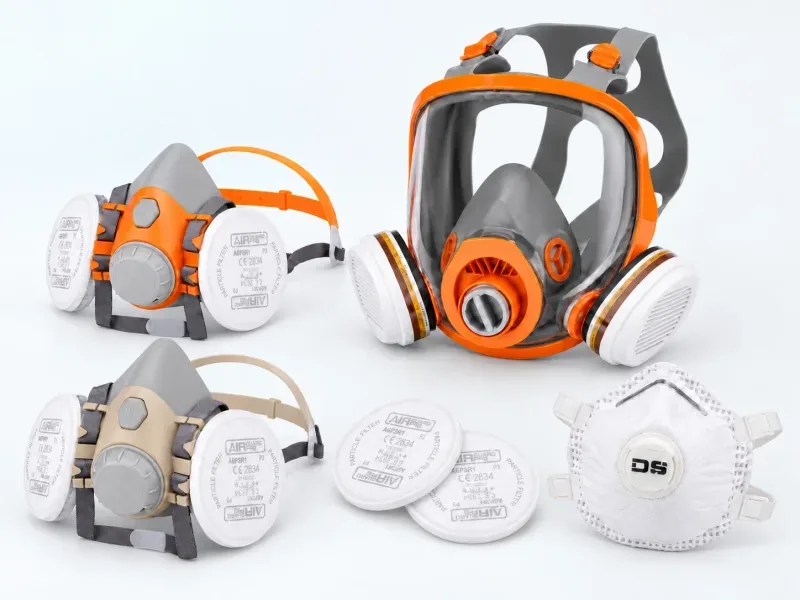
Gas filters with type A are the bayonet filters AGA1E1, AGABEKK1 and AGABEKK1P3 (each class 1, up to 0.1 % by volume). The P3 part in AGA1E1 and AGABEKK1P3 additionally holds back mist and dust, for example when spraying. You can see all filters in the filter overview.
| Class | Maximum | AirGuard Pro |
|---|---|---|
| Class 1 | 0.1 % by volume (1,000 ml/m³) | AGA1E1, AGABEKK1, AGABEKK1P3 (bayonet) |
| Class 2 | 0.5 % by volume (5,000 ml/m³) | AGA2E2, AGABEK2, AGABEK2P3 (RD40) |
| Class 3 | 1.0 % by volume (10,000 ml/m³) | not in the range |
Concentration and limit value
The filter goes with the question of how much solvent is in the air. The workplace exposure limit (AGW) is in TRGS 900 and in the safety data sheet. Divide the measured concentration by the AGW and you get the multiple. Up to 30 times the half mask is permitted, up to 400 times the full-face mask, each under DGUV Rule 112-190. How this works is shown in Workplace exposure limit (AGW).
What respiratory protection does not do
- It does not protect against absorption through the skin. Some solvents enter the body this way too. Gloves and protective clothing belong with it.
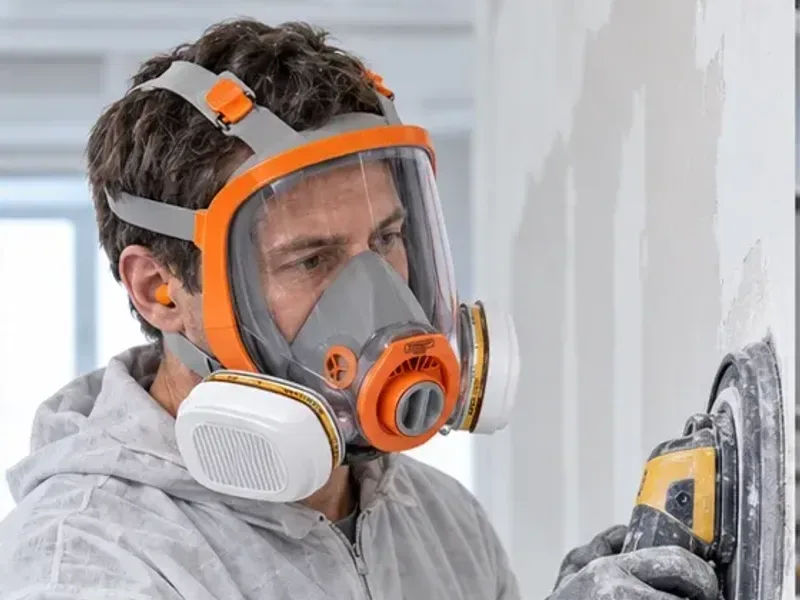
- A half mask does not protect the eyes. With irritating vapours or splashes the full-face mask AG700 is the right choice.
- It does not replace ventilation or extraction. These measures come first.
If you know substance and concentration, the respirator finder leads to the matching combination.
Frequently asked questions
Which respirator filter protects against acetone?
Acetone boils at about 56 °C. AX filters are intended for it, not type A. The AirGuard Pro range has no AX filter. For acetone contact us or the occupational safety specialist.
Does an A filter protect against toluene and xylene?
Yes. Toluene (about 111 °C) and xylene (about 138 to 144 °C) are above 65 °C. The exact suitability is in the safety data sheet of the product and in the instructions for use of the filter.
Where do I find the boiling point of a solvent?
In the safety data sheet, section 9, or in the GESTIS substance database. For mixtures it states the boiling range.
Which gas filter class do I need for solvents?
That depends on the concentration. Class 1 applies up to 0.1 % by volume (1,000 ml/m³). Higher classes are permitted only according to the instructions for use of the respective filter and at a known concentration.