Type B and type E: who protects against what
Under EN 14387 a gas filter of type B protects against inorganic gases and vapours. The instructions for use of the AirGuard Pro filters name chlorine, hydrogen sulphide and hydrogen cyanide for it. Type E protects against sulphur dioxide, hydrogen chloride and other acid gases. The identification colours are grey for B and yellow for E.
| Type | Protects against | AirGuard Pro |
|---|---|---|
| A | Organic gases and vapours with a boiling point above 65 °Ce.g. Solvents such as toluene, xylene or white spirit | in the range |
| B | Inorganic gases and vapourse.g. Chlorine, hydrogen sulphide, hydrogen cyanide | in the range |
| E | Sulphur dioxide, hydrogen chloride and other acid gases | in the range |
| K | Ammonia and organic ammonia derivativese.g. Amines | in the range |
| P | Particles: dust, smoke, miste.g. Classes P1, P2, P3 | in the range |
| AX | Organic compounds with a boiling point up to 65 °C | not in the range |
| SX | Substances named by the manufacturer | not in the range |
| NO-P3 | Nitrous gases (nitrogen oxides) | not in the range |
| Hg-P3 | Mercury vapour | not in the range |
Which AirGuard Pro filters fit
| Hazard in the air | Type | Filter (bayonet, class 1) |
|---|---|---|
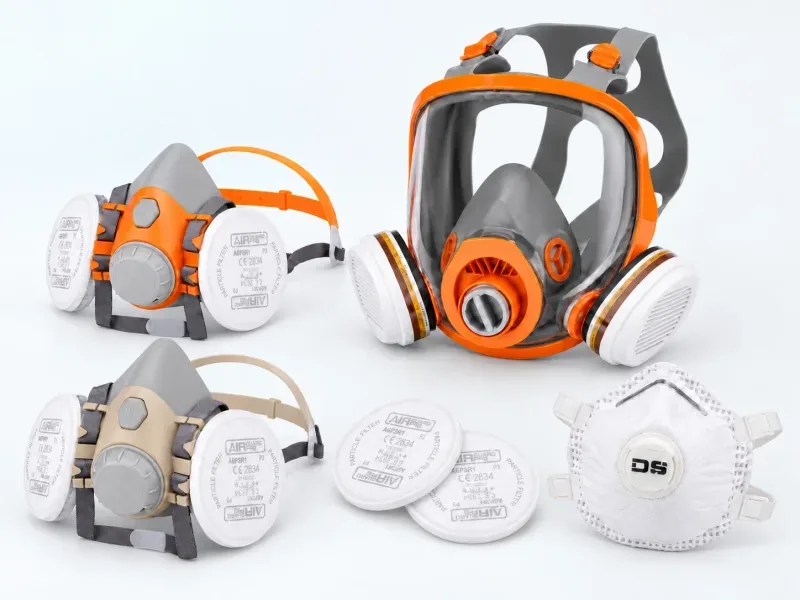
| Hydrogen chloride, sulphur dioxide (acid gases) | E | AGA1E1 (A1E1P3 R D) |
| Chlorine and other inorganic gases | B | AGABEKK1 (A1B1E1K1) |
| Acid gases with mist or dust | E or B with P3 | AGABEKK1P3 (A1B1E1K1P3 R D) |
Mask and limits
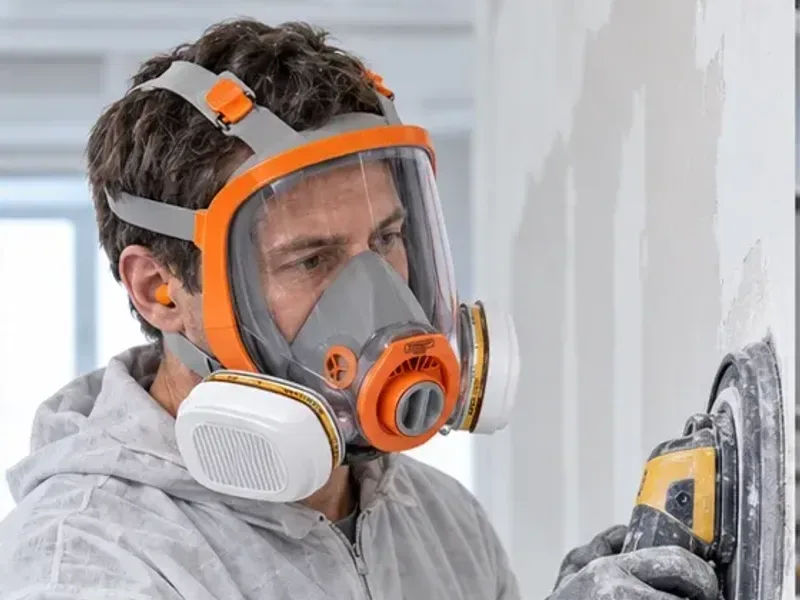
The half mask AG360 is permitted up to 30 times the workplace exposure limit under DGUV Rule 112-190, the full-face mask AG700 up to 400 times. Irritating gases attack eyes and mucous membranes. Where that is expected the full-face mask makes sense because it also protects the eyes. The gas filter additionally has its own limit: class 1 applies up to 0.1 % by volume, that is 1,000 ml/m³. The stricter value applies.
| Class | Maximum | AirGuard Pro |
|---|---|---|
| Class 1 | 0.1 % by volume (1,000 ml/m³) | AGA1E1, AGABEKK1, AGABEKK1P3 (bayonet) |
| Class 2 | 0.5 % by volume (5,000 ml/m³) | AGA2E2, AGABEK2, AGABEK2P3 (RD40) |
| Class 3 | 1.0 % by volume (10,000 ml/m³) | not in the range |
When a filtering respirator is not permitted
- Release, incident, unknown concentration: Without a known concentration there is no reasoned filter choice. In an incident you need a device independent of the ambient air.
- Oxygen not certain: Filters do not supply oxygen. In tanks, pits and confined spaces you need breathing apparatus independent of the ambient air. The instructions for use state at least 19.5 % by volume.
- Concentration above the protection level: above 30 times (half mask) or 400 times (full-face mask) the limit value.
- Substances without a matching filter: for example carbon monoxide, nitrous gases and mercury.
Never mix chemicals. Acid and chlorine-containing cleaners release chlorine gas. That belongs in the instruction, not in the filter.
Changing and checking filters
Change gas filters according to a fixed change schedule, at the latest at smell, taste or irritation. This is what the instructions for use of the AirGuard Pro gas filters say. We do not state a service life in hours. More under Changing filters and Face seal and beards.
If you know substance and concentration, the respirator finder leads to the matching combination.
Frequently asked questions
Which filter protects against chlorine?
A gas filter of type B (colour grey). In the instructions for use of the AirGuard Pro filters chlorine is named with type B, for example with the A1B1E1K1 filter AGABEKK1.
Does an E filter protect against hydrochloric acid vapours?
Yes, type E (yellow) protects against hydrogen chloride, sulphur dioxide and other acid gases.
Is a dust mask enough for acid cleaners?
No. FFP masks hold back only particles, not gases and vapours. You need a gas or combination filter for that.
May I work with a filter in a chlorine accident?
No. With a release and unknown concentration a filtering respirator is not permitted. A device independent of the ambient air is needed then.